June 17, 2026

On a busy day, the doctor sees a result on the screen that doesn’t fit with the rest of the clinical picture. It doesn’t have to be a dramatic case for the question to matter. Is the value correct? Was there a problem with the sample? Has the testing method changed? Is there a previous result to compare it with?
In laboratory medicine, a result is more than just a number. What matters is the context in which it appears: the patient’s medical history, the quality of the sample, the method used, and the clinical question the laboratory is trying to answer.
This is exactly where the role of AI begins to emerge.
In the laboratory, AI should not be viewed as a system that replaces the doctor, but rather as a tool that can organize information, flag anomalies, and reduce some of the digital fragmentation that consumes time and attention in day-to-day work.
That’s why perhaps the best definition is this: AI is a new colleague, not an autopilot.
What, specifically, can AI do in the lab?
In practice, the most useful applications are those that reduce the time wasted when switching between systems and handling large amounts of information.
An AI system can summarize the trends in repeated test results, compare current results with the patient's medical history, and flag significant differences that warrant review by a doctor.
It may indicate a change in methodology, a problem with the quality of the sample, or a critical value that requires immediate attention. It may provide a summary of the findings before the physician begins to review the results.
These tasks may seem administrative until you experience them firsthand in a laboratory where hundreds or thousands of samples are processed daily. A significant portion of occupational fatigue stems not only from medical complexity but also from the fragmentation of information: different systems, data spread across multiple applications, and results that must be correlated manually.
If AI succeeds in reducing this fragmentation, the benefits become real—both for the laboratory and for the pace of clinical decision-making.
The doctor remains at the center of the decision
In technology, there is a term called “human-in-the-loop.” In laboratory medicine, the concept is simpler: the physician remains at the center of the decision-making process and is responsible for the final interpretation.
AI can prepare the necessary materials, but it does not make decisions on behalf of the doctor and cannot fully understand the patient’s clinical context on its own.
The analogy with a resident is probably more useful than the one with a robot. A resident can draft a report or formulate a hypothesis, but it is the specialist who verifies, corrects, and decides what remains in the final interpretation.
The relationship between the lab and AI works the same way. The system can identify patterns or raise useful questions, but it is the doctor who determines whether those observations make sense for the specific patient in front of them.
This distinction is important. A result can be technically correct yet still be misinterpreted if it is taken out of its clinical context.
Implementation starts with small steps
Laboratories already have a culture of quality assurance and quality control. A new analyzer is not introduced directly into critical routine testing without comparisons, validation, and staff training.
The same principle should apply to AI systems as well.
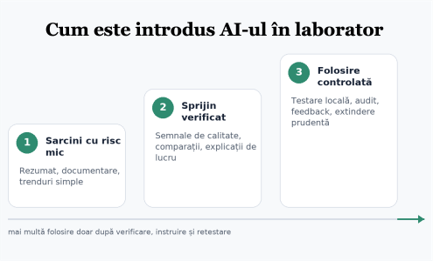
The first useful applications are those with low risk: administrative summaries, organizing patient histories, consistency checks, or preparing preliminary notes for the doctor.
Only later can more advanced features be introduced: automatic pattern recognition, complex comparisons of results, or support for interpretation.
Throughout all these stages, feedback from the doctor remains essential. It matters not only when the system responds correctly, but also when it makes mistakes and how those errors are identified.
Patient Data and Security
In the laboratory, medical data is not merely administrative information. A biological sample, a patient’s test history, and the clinical context can reveal a great deal about a patient’s life.
For this reason, the introduction of AI inevitably raises questions regarding access, security, and control over data.
For a laboratory or a hospital, the important questions are very specific:
- where the data is processed;
- who has access to them;
- how the use of the system is documented;
- and how to trace the path of an error or a change.
Security is no longer just an IT issue. It is becoming part of the laboratory's clinical responsibility.
Funding That Enables Testing and Implementation
In recent years, European funding programs have begun to support projects that bring together medicine, research, and technology. For hospitals and laboratories, these calls for proposals create an opportunity to test and implement AI solutions in a controlled environment, alongside partners from research and industry.
In practice, the value of funding lies not only in the acquisition of technology. What matters is whether the project allows time for local validation, integration into actual workflows, team training, and ongoing evaluation of results.
In the lab, useful AI is not the kind that tries to replace medical judgment, but rather the kind that supports it and gives doctors more context and more time to make decisions.
In conclusion, AI in laboratory medicine does not mean replacing the physician or fully automating the interpretation of test results.
Its value lies in its ability to reduce information fragmentation, organize relevant data, and allow the physician to focus more on interpretation and clinical decision-making.
In the coming years, the difference will not be made by the laboratories that use AI the most, but by those that manage to integrate it responsibly, gradually, and in a way that supports the medical team.
Andrei Ionuț Damian, Ph.D.
CEO, Ratio1.ai
Associate Professor, National University of Science and Technology "Politehnica" Bucharest