June 16, 2026
72h → 24h Antibiogram — from 72 hours to 24 hours for targeted treatment
The same city. Two hospitals. Two stories about how a medical laboratory is changing within a public system, with all its constraints. In Târgu Mureș, digitization also raised a question that Dr. Ovidiu Gârbovan simply asked himself: if it can be done, why not do it?
Love at First Sight
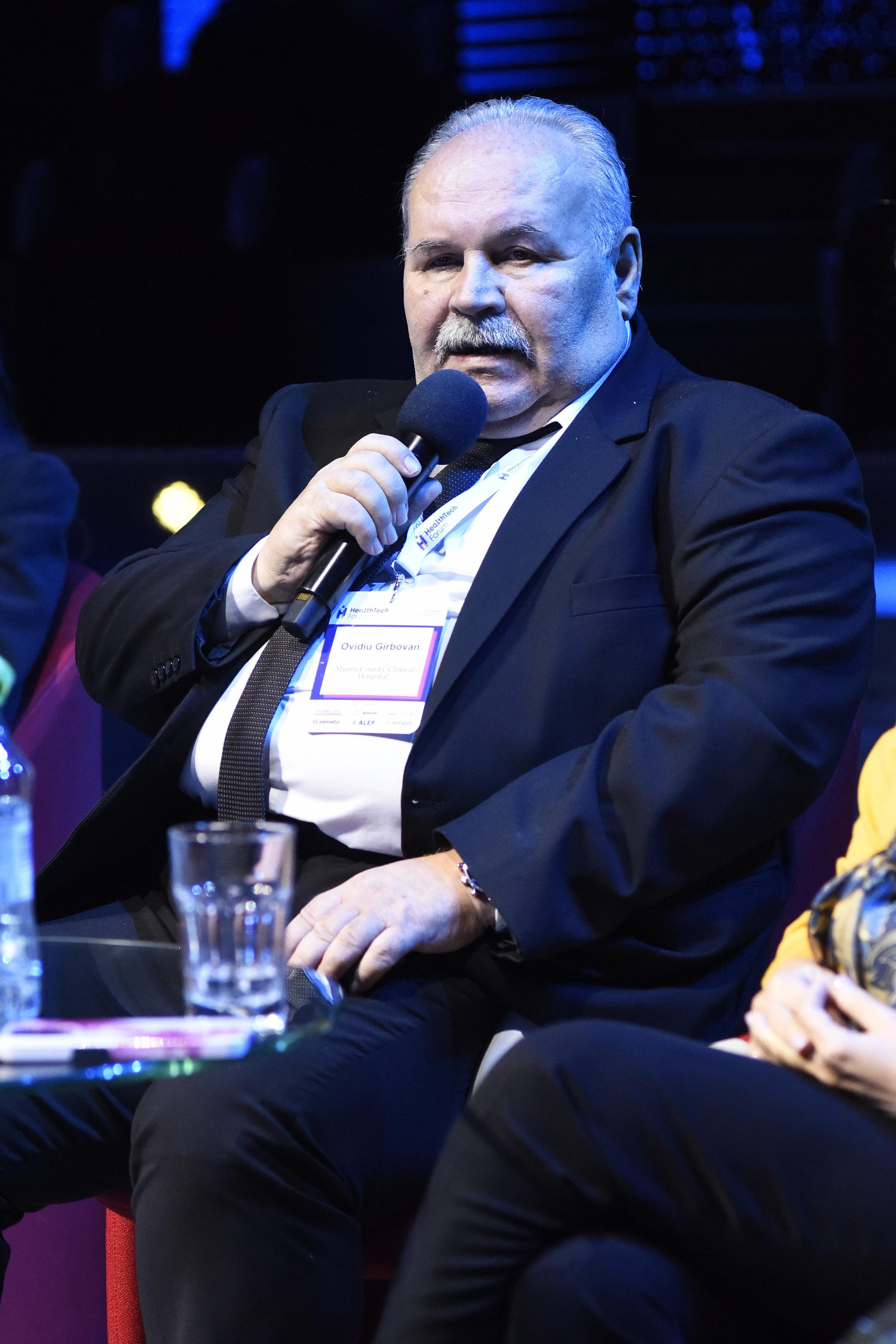
Dr. Ovidiu Gârbovan heads the County Clinical Hospital and says that, over time, “a bond has formed” among the people he works with.
The need was clear. The workload was heavy, response times were long, and the risks posed by manual workflows were becoming increasingly difficult to control. What had been missing until then was proof that it could be done.
He discovered it during a visit. He saw how a fully automated laboratory works in practice. He asked questions. He observed the speed, organization, and efficiency of the system.
““I saw a hospital where it had been implemented. It was love at first sight. And if it’s possible, why shouldn’t we do it too, especially since we’re such a large hospital?””
— Dr. Ovidiu Gârbovan, Manager, Târgu Mureș County Clinical Hospital
That hospital was in Oradea.
Just like Dr. Boca from Suceava and Prof. Dobreanu at the Târgu Mureș County Emergency Hospital, Dr. Gârbovan saw the model in action and decided to replicate it. The chain of inspiration continues.
The number that says it all: the antibiogram
Every hospital has its own figure—the metric that most clearly illustrates how digitization has changed day-to-day clinical practice.
At the Mureș County Clinical Hospital, this figure is the antibiogram.
Before automation, the results of an antibiogram were available after 72 hours. During this time, clinicians could not leave patients without antibiotic treatment, so doctors would start treatment with broad-spectrum antibiotics while waiting for the final results.
The problem is that resistant bacteria adapt quickly. Sometimes faster than it takes to get the test results.
Today, at the Mureş County Clinical Hospital, antibiotic susceptibility testing for resistant bacteria can be available in about 24 hours. The correct treatment begins sooner, and the patient receives the appropriate antibiotic much more quickly.
“Until recently, we had to wait 72 hours for the antibiotic susceptibility test results. You can’t leave a patient without any treatment. We would start with a broad-spectrum antibiotic and then switch to targeted therapy. Now, in most cases, we can wait 24 hours and start the correct treatment right away.“
— Dr. Ovidiu Gârbovan
The impact isn't limited to the laboratory. It's also evident on the wards: fewer days spent in the hospital, fewer ineffective treatments, and fewer complications.
Dr. Gârbovan says that the average length of hospital stay has begun to decline, particularly in the infectious disease and surgical wards, even though a detailed analysis of the data is still underway.
What It Means to Transform a Large Public Hospital
A digitization project at a public hospital involves more than just new equipment. At the Mureş County Clinical Hospital, the project included the automation of the clinical laboratory (chemistry and immunology), the integration of workflows, and digital traceability of specimens from five different collection sites.
The implementation involved not only installing an automation line, but also reorganizing the circuits, adapting the facilities, and coordinating several projects carried out simultaneously at the hospital.
This involves funding, procurement, PNRR deadlines, reorganization of space, and several large projects carried out simultaneously by the same administrative teams.
Dr. Gârbovan speaks openly about the pressure during implementation. The procurement and finance teams were working in parallel on several major projects, with deadlines that sometimes seemed impossible to meet.
“There were times when my colleagues would say, ‘We can’t do this anymore.’ But from my perspective, there wasn’t a single moment when I wanted to stop. I always said, ‘We have to do this. This is the future.’”
— Dr. Ovidiu Gârbovan
Behind the project, however, there was something else: a team that remained united around a common goal. Dr. Gârbovan talks about working with the County Council, the financial director, the procurement team, and Prof. Man, the lab coordinator.
“You can’t do anything on your own.“
— Dr. Ovidiu Gârbovan
The laboratory had to be adapted to fit into an existing infrastructure built during a different era of medicine.
“You can’t do anything on your own.“
— Dr. Ovidiu Gârbovan
The first in the county and in the region
The Mureş County Clinical Hospital has become the first automated laboratory in Mureş County and the first in the Central Region. For Dr. Gârbovan, this is less about personal achievement and more a sign that they are on the right track.
“Of course, others have followed our lead. That’s a positive sign.“
— Dr. Ovidiu Gârbovan
Just as teams from Târgu Mureș went to see the model in Oradea, this lab is now beginning to receive visits from other hospitals that want to understand how such a system works in practice.
The question is no longer whether it is possible
At the end of the discussion, the conversation inevitably shifts from the laboratory to the Romanian healthcare system as a whole.
For Dr. Gârbovan, one of the biggest problems remains the lack of interoperability among medical information systems.
“We don’t yet have a fully integrated system.“
— Dr. Ovidiu Gârbovan
This observation actually marks the next stage of digitization.
In many hospitals, the technology already exists. The real issue is the integration of the systems and their ability to work together.
Advice for Managers Just Starting Out
Dr. Gârbovan received visits from hospital administrators from across the country who were interested in the same model.
His advice is simple:
““Let him want it. Let him put together a good team and not give up until he makes it.“
— Dr. Ovidiu Gârbovan
He does say, however, that every hospital faces its own challenges. What works in one place cannot be replicated exactly in another. The direction may be the same, but the path isn’t always.
Târgu Mureş now has two hospitals with digitized laboratories. Two different institutions, two different teams, two different paths to the same result. What unites them is not just the technology. It is also the decision to adopt it, made by people who saw that it was possible and chose to make it happen.
Dr. Gârbovan concludes the conversation with a statement that speaks louder than any statistic:
“I did it for the people of Târgu Mureș. And I’m glad it turned out well.“
— Dr. Ovidiu Gârbovan
—
The Same City, Two Hospitals Târgu Mureş has two county hospitals with digitized laboratories: the County Emergency Clinical Hospital (Chapter 3) and the Mureş County Clinical Hospital (Chapter 4). They are separate institutions with different management, different funding, and different clinical profiles. The fact that both took this step during the same period is the result of a model that has spread through visits, conferences, and the professional network within Romanian medicine.