June 2, 2026
3 hours → 15 min — from sample collection to results
The model already existed in Romania, but at Dorna Medical, its implementation took place in a different context: a private healthcare network where rapid decision-making and a direct impact on patients accelerated the transformation.
The first step was taken in Iași, as part of the Dorna Medical network, an experience that laid the foundation for the development of the automated laboratory in Suceava.
In Suceava, the automation system was built in a laboratory with a high volume of tests and constant operating pressure, where processing speed and the predictability of workflows have become essential for both the patient and the attending physician.
30 Years of the Laboratory
Dr. Rodica Boca has been working in laboratory medicine for three decades. She built Dorna Medical alongside her husband, step by step, from a modest medical testing lab into a network of 45 locations across 7 counties. She has witnessed how technology has evolved, how the expectations of patients and doctors have grown, and how medicine has changed. She has come to understand that performance is no longer just about accuracy, but also about speed, predictability, and the ability to provide patients and doctors with answers when they need them most.
The decision came after a visit to Oradea, where he saw a large-scale automated laboratory model in operation.
“I saw what had been done in Oradea and made up my mind right then and there. I didn’t wait for anyone to convince me.”
— Dr. Rodica Boca, Laboratory Physician, Co-founder of the Dorna Medical Center, Suceava
As a private laboratory, the choice of solution was not subject to public bidding procedures. The team evaluated several options and selected Abbott’s infrastructure based on performance, technological compatibility, and system integration capabilities, as well as the solution’s long-term stability and its direct impact on the laboratory’s workflow.
The decision was a practical one, not a theoretical one: the solution had to handle a large volume of tests, reduce processing times, and enable the rapid transmission of results without compromising quality. At the same time, it was essential that the implemented system be reliable, stable in daily use, and capable of supporting the laboratory’s operations over the long term, including during periods of high sample volume.
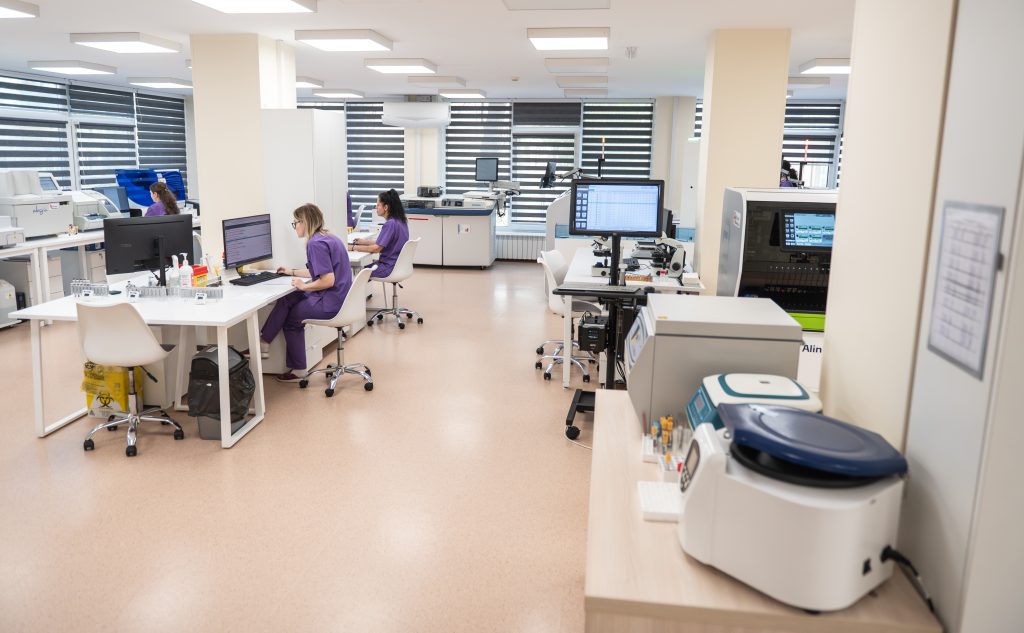
In a traditional laboratory, the workflow begins manually: each sample is checked, labeled, accepted, and then processed. For a few hundred patients, this means thousands of tubes processed manually, one by one, which is extremely time-consuming and places constant pressure on the lab team.
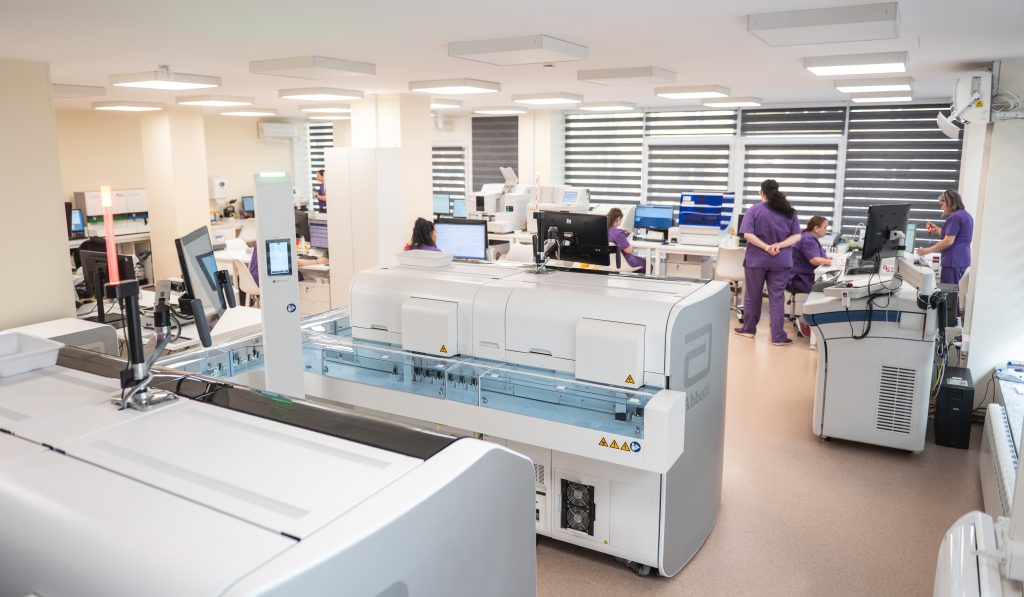
At the Dorna Medical laboratory in Suceava, this process used to take about three hours. After automation, it was reduced to a quarter of an hour.
The difference isn't just a matter of time. It's a matter of control and safety.
“We know at all times where each sample is, what’s being worked on, what’s next, and when each result will be ready.”
— Dr. Rodica Boca
Transportation is monitored, processing is automated, and the results are sent directly to the patient and the doctor.
For a laboratory where more than 60% of the samples arrive after 2:00 p.m., this change is essential: it makes the difference between a result available the next day and one that allows the doctor to make a decision that very evening.
In essence, automation is not just about reducing work time, but about increasing the laboratory’s ability to support rapid medical decisions during a critical window for both the patient and the attending physician.
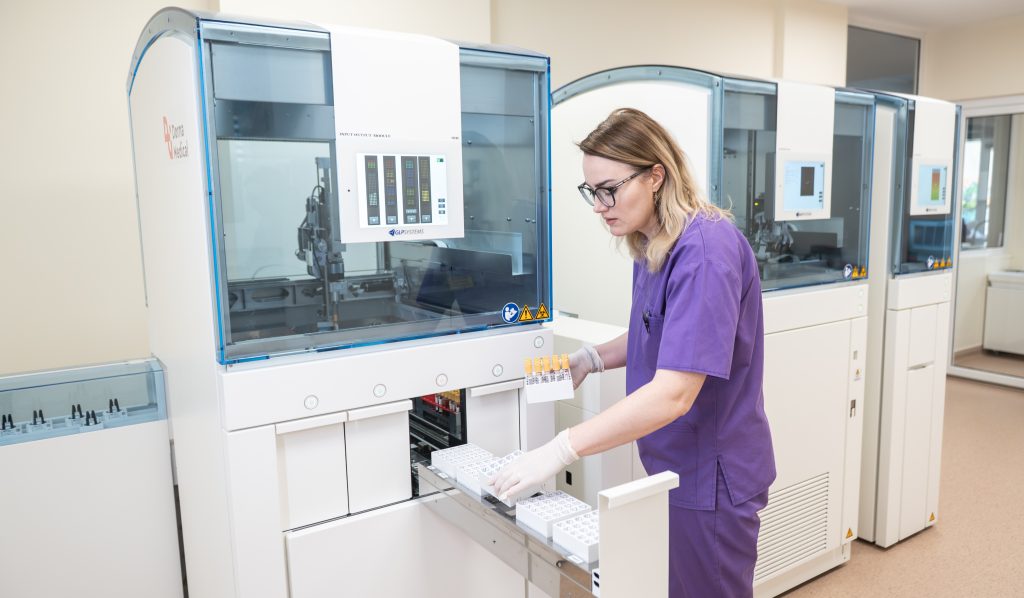
The Error That No One Sees
One of the key arguments in favor of automation was one that the general public knows very little about: 60% of laboratory errors occur before the sample enters the instrument. The preanalytical phase—transport, identification, and manual handling—is where the most common and serious errors occur.
Today, at Dorna Medical, every specimen has a complete digital trail: GPS tracking on the transport vehicle, an indexer that assesses the specimen’s quality upon arrival, and traceability from collection through to result validation. Human error in the preanalytical chain has been virtually eliminated, and the laboratory operates within a much safer, standardized, and predictable system, in which every step can be tracked and verified.
“The safety of the tests was the primary consideration. Not speed, not cost—patient safety. That’s where we started.”
— Dr. Rodica Boca
What Happened to the People
The question comes up every time: What happens to the staff?
At Dorna Medical, the answer is clear: no one has lost their job.
What’s more, the organization has grown, and automation has allowed the team to refocus on higher-value activities—not to be replaced. Automation did not mean cutting staff, but rather creating an environment in which specialists could work more efficiently, more safely, and with a greater impact on the medical process.
Starting with two doctors, chemists, and biochemists in the Suceava laboratory, the team has grown to include dozens of specialists. The network has expanded, and the laboratory has become the foundation for the development of the entire operation, supporting the growth of medical services, expansion into new locations, and the laboratory’s ability to handle an ever-increasing volume of patients. In other words, technology did not replace the team, but rather supported its development and laid the groundwork for a more complex, better-organized, and more sustainable operation.
“We haven’t lost a single person. We’ve gained capacity. That’s the difference that no one on the outside can see.”
— Dr. Rodica Boca
Automation has not reduced the amount of work; rather, it has made growth possible.
A Model for Other Managers to Follow
Dr. Rodica Boca visited the Bihor County Emergency Clinical Hospital (Oradea) before making her decision. She wanted to see for herself how the system works in practice, not just on paper.
Following implementation, the Dorna Medical diagnostic laboratories in Iași and Suceava have, in turn, become points of reference for those who want to see how such a system operates in a real-world laboratory, with daily workflows, operational pressures, and direct responsibility toward patients.
The advice he gives to any manager just starting out is simple and practical: go see a lab that’s already up and running. Ask questions. Ask about what was difficult, not just what went well. And then make a decision, with a complete picture of the benefits, challenges, and real impact that automation can have on a healthcare organization.
“Courage, initiative, and desire. These are the three things you need to get started.”
— Dr. Rodica Boca, in response to the question, “What is the healthcare system lacking in order to become more digitized?”
The story from Iași and Suceava shows that, sometimes, transformation doesn’t start with a plan—but with a decision made before all the answers are clear.
For Dorna Medical Analytical Laboratory, this decision paved the way for a faster, safer, and more future-ready laboratory—one where technology supports people, and results reach those who need them most—the patient and the doctor—more quickly.
How do you implement the system without interrupting operations? Operations do not need to be completely halted during implementation. Solutions vary depending on the context: emergency testing is temporarily moved to a dedicated space; the rest is outsourced for a limited period; implementation can be carried out in phases, segment by segment, so that business continuity is maintained as much as possible. In public hospitals, the transition must be planned in phases.
How long does a project take? The Dorna Medical experience : ~6 months for full implementation (installation, calibration, commissioning), of which 2 months are for the actual installation and the rest for design and remodeling. In the public sector, the preparation phase (funding, procurement) can take years.